
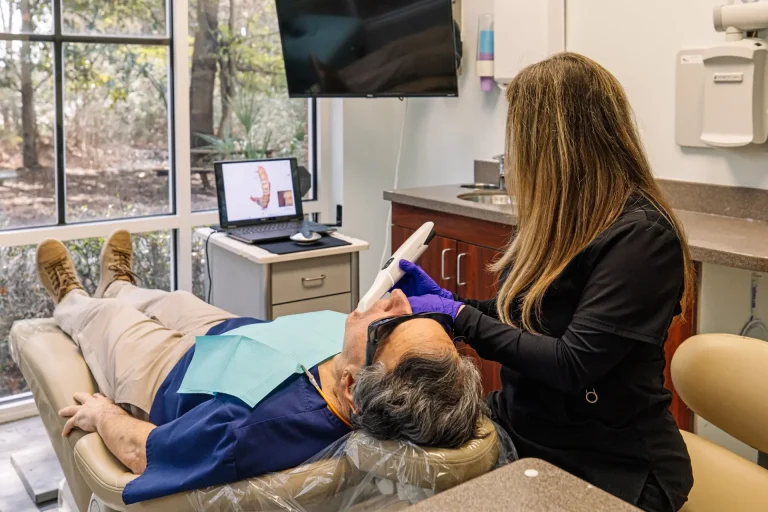
“Root canal” might be the two scariest words in dentistry, but the procedure itself has a reputation problem that doesn’t match reality. If you’ve been told you need one, here’s exactly what happens, step by step, so you know what to expect before you’re in the chair, plus what recovery actually feels like and how to know if you’re a good fit for sedation if the idea alone makes you anxious.
Root canals earned their scary reputation decades ago, before modern anesthesia and technique made the procedure far more comfortable. Today, most patients report that a root canal feels similar to getting a filling, and the pain you’re likely feeling right now, from the infection itself, is far worse than the treatment that resolves it. The procedure exists to relieve pain, not cause it.
Root canal treatment is a dental specialty in its own right, called endodontics, and it’s worth knowing who’s actually doing the work. Dr. James Warner has completed specialized training in endodontics alongside implant dentistry, oral conscious sedation, and TMJ therapy, and holds Fellowship status with the Academy of General Dentistry, a distinction fewer than 5% of dentists nationwide achieve. That combination, endodontic training plus sedation training, matters specifically for patients who are anxious about this exact procedure.
If the thought of a root canal alone is enough to make you put off treatment, you’re not alone, and it’s a solvable problem rather than something you have to push through. Dr. Warner’s training in oral conscious sedation means patients who want to be fully relaxed, not just numb, during treatment have that option available. It’s worth mentioning your anxiety level when you schedule so the team can plan for it in advance rather than discovering it in the chair.
Your dentist thoroughly numbs the area around the affected tooth with local anesthesia, the same kind used for fillings. You’ll be awake and comfortable throughout, and most patients feel little more than pressure once the numbing takes effect. A small protective sheet, called a dental dam, is placed around the tooth to keep the area clean and dry during treatment.
A small opening is made in the top of the tooth to reach the pulp chamber, the space inside your tooth containing the nerve tissue and blood vessels that have become infected or inflamed. Using fine instruments, your dentist carefully removes the damaged pulp and cleans and shapes the narrow canals inside the tooth root, removing bacteria and debris that caused the infection in the first place. The number of canals varies by tooth: front teeth typically have one, while molars can have three or four, which is part of why molars sometimes take longer to treat.
Once the canals are fully cleaned, they’re filled with a biocompatible material and sealed to prevent future infection. This step is what actually “saves” the tooth, restoring the internal structure so the tooth can continue functioning normally, even without the nerve tissue that originally occupied that space.
Because a tooth that’s had a root canal can become more brittle over time, most root canal-treated teeth need a protective crown placed afterward to restore full strength and prevent cracking. This is typically done at a follow-up visit once any initial sensitivity has settled, and it’s not an optional upsell, it’s what keeps the treated tooth from fracturing under normal biting force down the road.
Most root canals are completed in a single appointment lasting 60 to 90 minutes, though more complex cases, such as molars with multiple canals or teeth with unusually curved roots, may require a second visit. If you’ve opted for oral conscious sedation, plan for a longer overall appointment window and arrange for someone to drive you home afterward. Your dentist will let you know what to expect for your specific tooth during your consultation.
Mild soreness for a few days is normal and typically manageable with over-the-counter pain relievers. Most patients return to normal activities the same day or the next, and the pain from the original infection, which is often what brought you in, is usually gone almost immediately once the source of infection is removed.
A few practical notes for the first few days: avoid chewing directly on the treated tooth until your permanent crown is placed, stick to softer foods if the area still feels tender, and keep up your normal brushing and flossing routine around the site rather than avoiding it. If pain worsens after the first couple of days rather than improving, or you notice swelling, that’s a reason to call the office rather than wait it out.
When a tooth is infected, extraction is technically always an option, and occasionally it’s the right one. But in most cases, saving the natural tooth through a root canal is preferable to removing it, because your own tooth root continues to help preserve the surrounding jawbone and keeps your bite functioning the way it always has, without the added step of replacing what’s missing. Extraction becomes the better path mainly when the tooth is too damaged, cracked, or structurally compromised to save, at which point replacement options like an implant or bridge come into the conversation instead.
Once your permanent crown is placed, a root canal-treated tooth can function normally for the rest of your life with the same care you’d give any other tooth. It’s no longer alive in the sense of having nerve tissue inside it, so it won’t develop a new cavity-related toothache the way a natural tooth can, but the surrounding gum and the crown itself still need regular brushing, flossing, and checkups. Skipping those visits is the most common reason a treated tooth eventually runs into trouble, whether that’s a cracked crown, gum recession around the site, or a new infection developing at the root tip years later. Treat the tooth as fully restored, not as finished business you can stop paying attention to.
Cost is a common reason patients delay treatment, and it’s worth addressing directly rather than avoiding. A root canal is almost always less expensive in the long run than extraction followed by a replacement tooth, since you’re treating the problem once rather than treating it and then rebuilding what was lost. Many dental insurance plans provide meaningful coverage for root canal treatment as a standard restorative procedure. Our insurance and financing page outlines the plans we work with, and our team can verify your specific coverage before you commit to treatment.
Patients almost always tell us the anticipation was worse than the appointment itself. You can read that in their own words on our patient testimonials page, alongside experiences from patients who came to us anxious about all kinds of procedures, not just root canals.
Is a root canal more painful than a filling?
Most patients report the two feel very similar, since both involve local anesthesia and a numb, pressure-only sensation throughout.
What happens if I skip the root canal?
The infection doesn’t resolve on its own. Left untreated, it can spread, cause an abscess, and ultimately lead to tooth loss, at which point extraction and replacement becomes the only remaining option.
Can I drive myself home afterward?
If only local anesthesia is used, yes, you’re able to drive yourself home immediately after the appointment. If you choose oral conscious sedation, you’ll need someone to drive you home instead.
How do I know if I need a root canal?
Persistent tooth pain, sensitivity to hot or cold that lingers, swelling, or a darkening tooth are common signs. Our guide to the signs you may need a root canal covers this in more detail.
Can a tooth need a second root canal?
Occasionally, yes, if a new infection develops around an old treatment. It’s uncommon, but it’s treatable, and it’s one more reason a properly fitted permanent crown after your initial treatment matters.
Will my anxiety be taken seriously if I mention it?
Yes. Tell the team when you schedule so options like oral conscious sedation can be planned in advance rather than raised for the first time in the chair.
Tooth pain that’s severe, worsening, or accompanied by swelling can be a dental emergency. If you’re dealing with that right now, don’t wait for a routine appointment, contact our emergency dentistry team directly or call (843) 388-9894. For scheduled root canal care, we treat patients from Mount Pleasant, Charleston, North Charleston, and Daniel Island.